What is Brave Origin
Brave is great as a browser, but most of the side products just add noise to the user experience, and users are not happy about it.
Because of that, in June 2026, Brave launched Brave Origin, a parallel version of the Brave Browser without the side business attached.
It's basically Brave without the VPN, Playlists, the Web3 Wallet, Brave Rewards, Leo AI, and others.
There is only one caveat: it costs $60 (for a lifetime license on up to 10 devices).
So yeah, Brave is charging you for fewer features.
Why browsers are being enshittified
Brave is making you pay for a problem they've created.
This is the title of a popular YouTube video on this topic.
I understand why people see this as a dark pattern, but we actually need to understand why Brave, like many other browsers, has slowly turned the browser into a distribution channel for other products.
This process is indeed called "enshittification".
Enshittification, also known as platform decay, is a process in which two-sided online products and services decline in quality over time - Wikipedia
This phenomenon, when it comes to browsers, is not limited to Brave: in recent years, one of the most beloved browsers, Mozilla Firefox, has been the subject of much criticism from the community for the injection of poorly regarded add-ons into the application.
Firefox is not immune either. It currently shows Temu as a sponsored shortcut on the New Tab page and has also pushed Firefox VPN directly into the browser UI.
While it may seem like an evil strategy driven by craving and greed, the reason is more about the unsustainable business model of free, privacy-focused, and user-first browsers.
Have you ever wondered how companies developing browsers survive? Well, we have different cases to analyse, let's see a few cases:
- Safari is not really free. It is bundled into Apple’s operating systems and funded by Apple's hardware and services business.
- Chrome is free because Google does not need to sell you a browser. Chrome is the gateway to the ecosystem that makes Google money: search, ads, accounts, tracking, and personalisation.
- Other browsers use the browser as a distribution channel for more profitable products: VPNs, AI assistants, crypto wallets, subscriptions, sponsored shortcuts, and more.
Someone once said that if a product is free, it's because you are the product. And that's not an exception when it comes to browsers. If we exclude browsers such as Safari, which is effectively a paid browser (now you know it), all the others are free, developed and maintained by companies, which somehow must generate profits for their producers.
So say hello to VPNs, relays, suggested extensions, sponsors, and more to your browser.
Free and privacy-first browsers are a lie
Whenever a company is developing a browser, and you are not paying for it, there must be a business model based on cross-selling and data selling.
I already know you are going to scream, "but there is this browser that is really privacy-first and has no shit features integrated!". Well, let me clarify that there are three options for that:
- The project is still too young: companies are building privacy and user-first browsers to attract more users, but the moment they need to come to their balance, at that point they'll have to make a decision. And that decision is, of course, trying whatever cross-selling of their VPN, of their own AI assistant, sponsoring questionable websites, etc.
- They're lying to you.
- It's a group of people with beautiful values carrying the project, but it won't last long.
There is no way to make a browser sustainable if you either don't make the user pay for it or sell something else through it.
Mullvad Browser is free because Mullvad sells a VPN. LibreWolf is free because volunteers maintain it until they no longer want to. Firefox is free because Mozilla has search deals, sponsored placements, VPN, Relay, Pocket, and other products around it.
These are not exceptions. They are examples.
I'm fine with paying for privacy
If the choice is between paying for privacy directly and paying for “free” products indirectly, I prefer paying directly.
I am fine with accepting the uncomfortable part: there is no third way at scale.
People can't live on good intentions or air, but they need to make a profit. A small group of well-meaning open source developers can maintain a fork for a while. They cannot magically fund a modern browser forever.
This year, I have already decided to opt for payware alternatives to free ones to preserve my privacy and a decent user experience.
I have switched from free search engines to Kagi because I'm fine with paying for a search engine if it prevents what I search from being sold to companies to target my preferences and provides and if it gives me a cleaner search experience instead of a feed polluted by SEO spam, AI slop, and keyword-stuffed garbage.
I have switched from Google to Proton for my personal and business email, for privacy reasons.
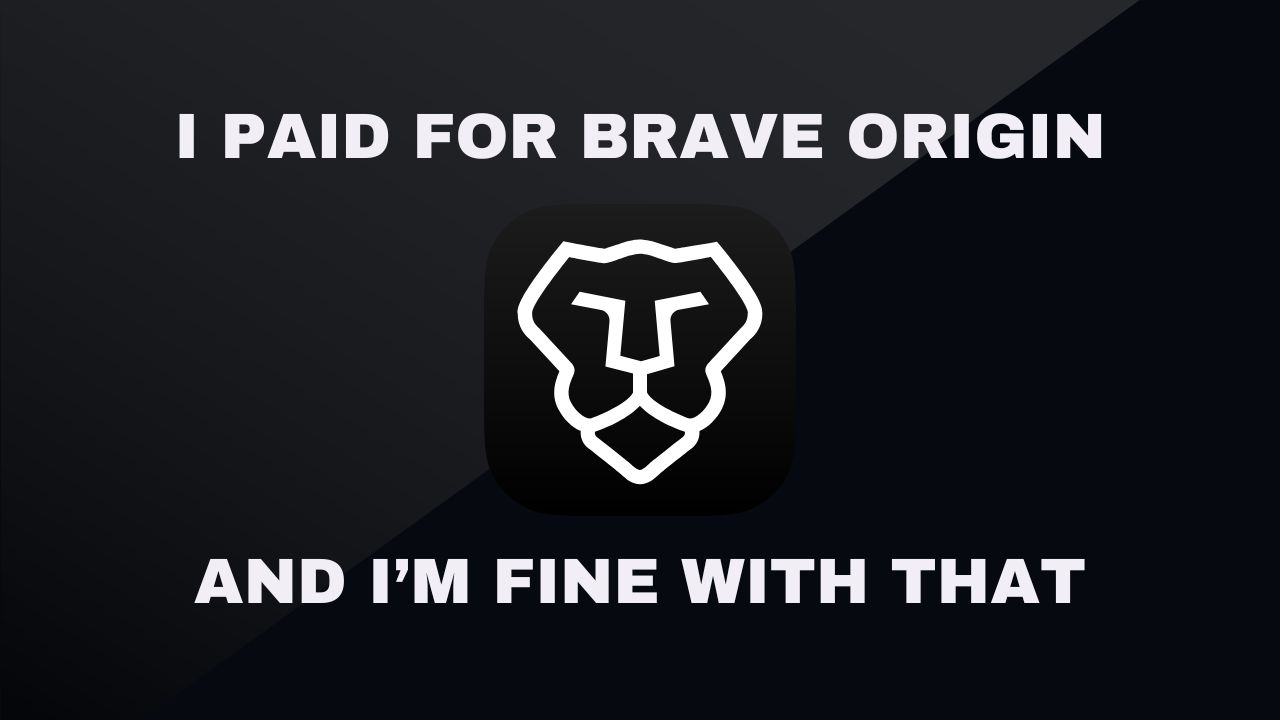
And for the same reasons, I have decided to pay for Brave Origin, and I'm fine with that.
Conclusions
It is easy to accuse Brave of charging users to remove a problem they created. And honestly, I understand the reaction.
But the bigger problem is not Brave Origin. The bigger problem is that we still pretend browsers can be free, private, clean, well-maintained, and economically sustainable at the same time.
And that leads to the most uncomfortable conclusion: if privacy depends on paid products, then privacy becomes easier for people who can afford it.
I do not like that. But pretending the bill does not exist will not make privacy more accessible. It will make it harder to see who is paying for it.