Four years of attending conferences
In 2023, I attended my first conference. I went to London for Rust Nation 2023.
Rust Nation '23 was amazing for me. So amazing that after I got home, I immediately bought tickets for EuroRust '23, and then I kept attending conferences year after year.
In November 2025, I even gave a keynote at RustLab in Florence.
Unfortunately, after attending RustNation '26 and being rejected by different conferences in 2026, I eventually lost interest in attending more.
I gave up on Rust conferences and promised myself I would never attend another one unless I'm invited or someone else pays for the ticket
What made Rust conferences great
When I first attended Rust Nation '23, I was amazed by how vibrant the community felt, by all the people going there, happy to be part of that community, and building amazing things.
The keynotes focused on amazing community projects and pushing Rust to its limits.
Most people attending those conferences were really glad to be there, and it was obvious they wanted to be there (it seems dumb, but trust me, it's not).
While some companies already backed the organization and hosted panels, most of what you saw at the venue was made by people like me. Developers put passion into their work to build amazing software.
And most importantly, every time the conference was over, you came home, and tons of ideas immediately started popping into my head about all the things you could do now. Many of the open-source projects I've implemented over the years came from some crazy idea someone showcased on stage.
But that changed after Rust Nation '26.
What was wrong with Rust Nation '26
In February 2026, I went to the Rust Nation conference. I'd been there 3 years before, and this time it was extremely disappointing.
The only reason I'm happy I went to London is that I stayed there for a week, and during that week I got to see many places I haven't seen in a long time, such as Windsor Castle. Also, for the first time, I got to visit the Warner Bros. Studio Tour for Harry Potter.
What does this have to do with the conference, you may ask. Well, absolutely nothing; I was just talking about the things I liked about that week in London.
The conference was sad. I have no data on attendance, but I think it was like 1/3 of 2023 (if not, it really felt like that); nobody was thrilled. If I had to use one word to describe it, I would say bland.
How was the atmosphere? Bland.
How were the keynotes? Bland.
How were the people? Bland.
But most importantly, once I arrived at my hotel that evening, after the conference ended, I just felt empty. No more new ideas, just nothing. I basically can't remember a single keynote from that conference.
I've talked to no one except companies trying to sell me products they weren't even enthusiastic about.
And apparently, it's not just me
Before you dismiss this as me being bitter about a bad conference or a few rejected CfPs, I've noticed I'm far from the only person feeling this way.
Just a few weeks ago, a discussion on r/rust about Rust conferences being increasingly unaffordable attracted a lot of attention. Besides the obvious complaints about €600+ tickets, several people independently described the same shift I've been feeling: conferences that used to feel community-driven now feel increasingly corporate, with more emphasis on company narratives and less on weird, exciting projects.
Now, Reddit is not data, and this obviously doesn't prove my explanation for why conferences have changed.
But it does tell me that the feeling itself isn't mine alone.
Why Rust conferences got bland
You may say: "ok, Rust Nation '26 was an exception, but not all conferences are like that", but sadly, it is not, and I had more confirmations throughout the year.
But why? What happened to Rust conferences?
Keynotes are good, but not interesting
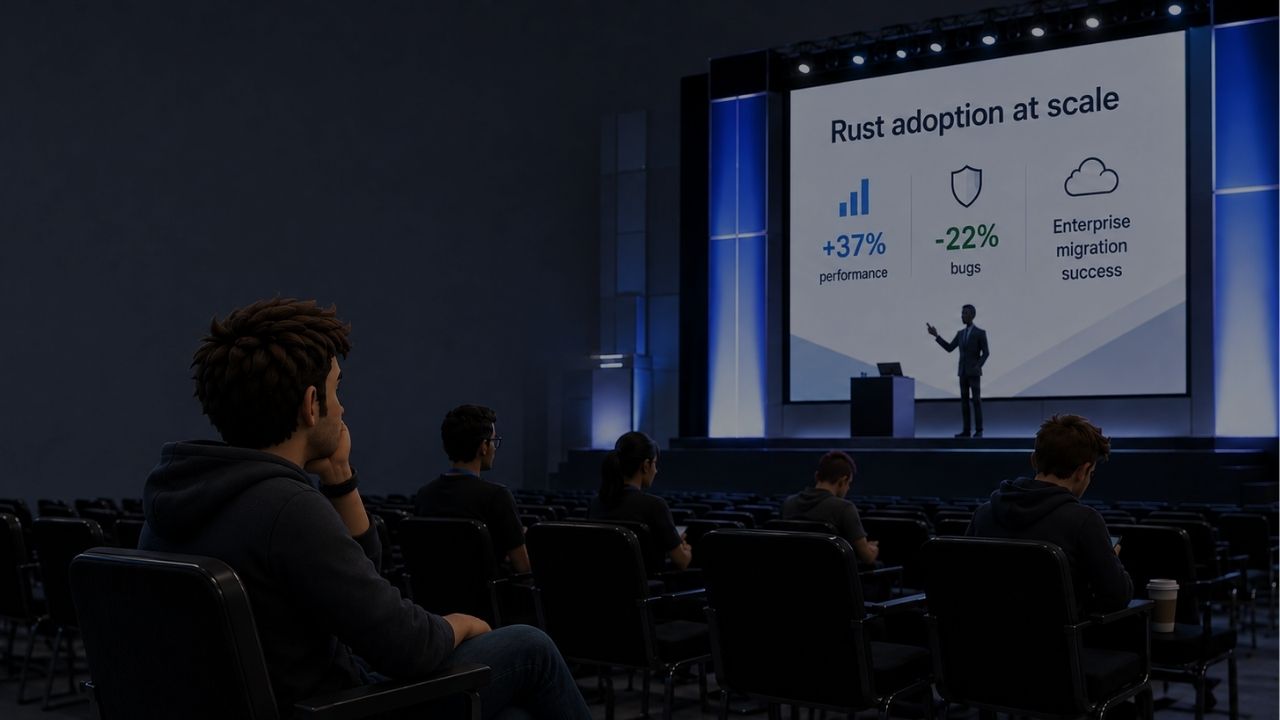
Between 2025 and 2026, Rust conferences have seen a major turnabout in keynotes: Over the last year, corporate and enterprise-adoption talks have become much more prominent in the conference programs I've followed
Big companies have the chance to bring talented speakers and good slides - almost perfect, I'd say - but, in my opinion, most of these keynotes are not interesting at all and never feel genuine.
The formula is always the same: we had to do X, we opted for Rust because we'd heard it was great, the adoption was challenging, but we managed it, and now performance has increased by X%, we have reduced bugs by Y%, and devs are really happy.
Hello? I've worked with Rust for more than 7 years. I know Rust is great; I don't need Nvidia reminding me that.
Where are the ideas? Where is the innovative or crazy stuff people used to showcase at conferences?
Damn, I can still perfectly remember the EuroRust '23 alternative controllers keynote, and I can't name a single keynote I've seen in the last year. Guys, can we, like, wake up from this crap? How can a keynote from an independent dev making crazy stuff be better than any keynote brought by put the name of any billionaire company here?
Also, am I the only one who feels they're not genuine at all? Well, let me tell you a thing: they are not.
Most of Big Tech doesn't necessarily send the engineers who actually did the work. Companies often send people who are good at representing the company on stage, such as developer advocates and managers.
The story they tell you about never happened as it's told; it's all part of the company narrative. And that's why it ranges from "extremely crazy to be true" to "impersonal, it's just numbers".
Calls for papers are a waste of time
But why do we still give so much space to big companies at conferences, if their keynotes are so boring?
Well, the reason is that calls for papers (CfP) have become a huge waste of time.
"I’m new to Rust — should I still submit?" Absolutely, we'd love to feature talks across all levels of Rust expertise. Beginner stories and fresh perspectives strengthen the ecosystem.
This is quoted directly from the Rustconf sessionize CfP page. After looking at what actually gets selected, that sentence has started to feel almost insulting.
It could have made sense in 2016, but now it's just a lie.
I've made 4 proposals this year, and let me tell you one thing: my papers were good. I will not paste the content here, but one was about Wasm Dbms and the other one was about Vendoring C dependencies in Rust (not just that it's in the article, but much more elaborated, with fun things you can do with it).
And I got rejected every time. Then I looked at the programs that made the cut and kept finding the same kinds of talks I'd already heard before: another Rust-adoption story, another generic industry problem, another variation of a talk I'd seen the year before
"Are you mad?" Yes, I am. If my CfP had been rejected because of something good, some brilliant idea, I would complain about nothing. I would even buy the ticket to see that keynote. But sorry about that; being rejected for a keynote no one could ever be interested in is just soul-crushing.
Sponsors polluting keynotes
Big companies sponsor conferences; big news.
And this isn't entirely speculation. Some conferences explicitly include speaking opportunities in sponsorship packages, while others openly mark sponsored workshops or sponsor slots in their schedules
I'm not saying this is corruption. I'm saying it changes what the stage is for.
It's easy to notice that, though not all the slots are sponsored, many are still "won" by big tech companies. Why?
Well, in my opinion, there are mainly two reasons:
- Conference organizers don't want to reject those who fund the event.
- Sounds appealing, and then makes tickets easier to sell (not to sell more; easier to sell).
From people to companies
The shift in the appeal factor in recent years, from interesting projects to interesting names when selling conference tickets, has made me wonder whether the audience has changed.
In the last year, Rust has become much more popular in the enterprise world. It has shifted from individual devs proposing Rust adoption to companies, to companies choosing Rust at an organizational level, before individual developers are even part of that decision.
This has caught the attention of conference organizations: our audience is now companies, not individual devs; and what makes a conference appealing to managers? big names, of course. The confirmation bias that you're not making the wrong choice, because that popular company is also using Rust.
This phenomenon has totally changed not only the audience, but the attendees as well. Do you remember when I earlier defined people at Rust Nation '26 as bland? Well, it's exactly the effect of this shift.
People attending conferences aren't thrilled to go, because their companies usually send them. The days when Rust enthusiasts asked their managers to buy tickets for them are gone. Welcome bored developers who attend conferences just to lose a day of work.
A ticket can't be that expensive
But what happened to the people who were really happy to go?
Well, you know, since the main goal is now to bring in companies, they decided to milk big tech companies by increasing ticket prices, so individual devs, who are no longer the target, can't afford conferences.
As a person who is self-employed, going to a conference has become part of this process for me:
Should I go on holiday for one week with my wife, or attend a two-day conference?
I'm not joking. Conference tickets really have become significantly more expensive.
RustLab's full conference ticket went from €380 in 2024 to €460 in 2026. RustConf is another example: in 2024, an individual ticket cost $450 and an industry ticket $600. In 2025, those had increased to $525 and $775, respectively. Even after prices came slightly down in 2026, standard tickets still cost $495 for individuals and $745 when paid for by an employer.
These aren't insane increases in isolation. Conferences are expensive to run, and inflation exists.
But when you're paying out of your own pocket, a 20% increase on an already expensive ticket matters, especially once you add flights, hotels, food, and two or three days you're not working.
Companies don't really have this problem.
Guess who conferences can increasingly afford to optimize for? Yeah, big tech companies.
Aren't you happy now? Aren't you thrilled to attend conferences where only big-tech employees can still afford to go, talking about invented stories, recycled more times than a LinkedIn post, that aren't even told by those who experienced them? What about talking with other devs with zero interest in Rust?
I'm really thrilled to announce I'm taking a one-week holiday with my wife instead. Enjoy.
Conclusions
Sorry for the rant. Believe it or not, this is the balanced version.
And to be clear, I don't think conference organizers are getting rich from this. Conferences are ridiculously expensive to run, sponsors are necessary, and companies paying for expensive tickets probably keep many of these events alive in the first place.
My problem is not that companies are at Rust conferences. Companies adopting Rust is great.
My problem is what happens when the conference gradually starts optimizing for them.
A conference that used to sell excitement starts selling reassurance: look, this huge company uses Rust too; they migrated X to Rust; performance improved by Y%; management made the right choice.
That's exactly what managers want from a Rust conference, but it's not what we in the Rust community want.
I already know Rust works. I've been using it for more than seven years. I don't need another company to convince me that adopting Rust was a good idea. I want someone to show me something insane they built with it. I want to discover a crate I've never heard of, an absurd hardware project, a compiler experiment, or some terrible idea that somehow works.
I want to leave the conference wanting to build something.
That's what Rust conferences used to give me, and that's what I feel I've lost.
Maybe this is simply a side effect of Rust's success. The community didn't disappear; perhaps the big conferences just aren't primarily built for people like me anymore.
I'll spend my money elsewhere and keep attending places where I can still meet people genuinely excited about Rust, whether that's Rust Milan, a local meetup, or some tiny event without a €600 badge around my neck.
If big conferences ever become that place again, I'll happily come back.
Until then, enjoy the Rust adoption keynote. Me? I'll be on holiday with my wife.